|
All based on the memories of
Alan George Keeler 02.02.1923 -
George Keeler (I)
master builder died 1926
St Albans, Eythorne, Kent
A successful man who retired in some style when he was 40. 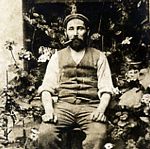
We: Mother, Father, Marjorie and I, visited the house in the late 60’s where the widow of the man who bought the house from Great Grandfather still lived.
The house has a Victorian front imposed on a much older timber framed construction. (I wonder if he had the alteration done. It’s the right period). I was told the house had been a village school at one time. It is a long house, nevertheless the school must have been very small. The house faces south overlooking Waldershare Park. It had had several acres of garden but much of that had been sold off by the time we went there. (An old ordnance survey map would show the extent of the land).
I know little about my Great Grandfather other than my father always spoke affectionately about him.
George Keeler II
1869-1934 est
A general builder with his brothers in partnership. It went bankrupt, to the horror of their father. He bought the Hope Inn on Lydden Hill which my father said was to entertain himself and a doctor friend. 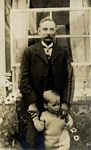 His wife hated it and the marriage broke up. His wife hated it and the marriage broke up.
He went to Leicester and worked as a brick layer. According to Father he was a brilliant craftsmen and estimator but an indifferent businessman. Grandmother moved to Whitstable and opened a small shop. My mother said that they were a quarrelsome couple and ill suited to each other.
(pictured here with Alan
aged 2yrs 4 months)
Grandfather stayed with us for a week about 1933 but I don’t remember much about him. I think he was emotionally a cold man. I only remember seeing Grandmother Keeler once when I was about 7. I suspect it was to be shown her new grandson, John. It was not a happy visit according to Mother.
The daughters, Eva and Grace, had private education whilst the boys, Father and Jack went to the local elementary school and left to go to work at 13 or 14. That the boys were not given a proper education when money was not a problem was to my mother selfish stupidity beyond belief.
THE CHILDREN OF GEORGE II
EVA
From what I remember Eva was the only child to inherit her parents quarrelsome, selfish and devious nature. She was also a snob according to my mother.
When their parents separated she took her mother’s side and objected to any show of warmth that her brothers and sister might make towards their father. Father was adamant that he wasn’t going to take sides. Eva then did much to poison the relationship between him and his mother. A difficult woman.
When young she was very beautiful with a mass of chestnut coloured hair.
Eddy, her husband, was well liked. I don’t remember him very well. The girls, Mavis and Doreen, were a little older than me, 4 years and 18 months, Derek 5 or 6 years younger.
I remember them when I was young and we met later, probably at a funeral. They were very agreeable, Derek I don’t really recall as a child, we met in the 50’s and he looked similar to Murray but with red hair. He spent most of his working life travelling the world as a fitter for an engineering company. He never married and when home lived with his younger sister. I have lost touch with all of these cousins.
GEORGE III
Thank goodness his character was totally different from his sister Eva. He was open, a man without ‘side’, friendly to one and all whatever their status. I would say he was a man at ease with himself. He had had a difficult life but did not complain. That is not to say he was blindly uncritical; he could be very sharp of what he considered to be slackness or dishonesty.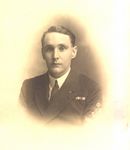
With only an elementary education he was sent to work at a firm of shipwrights in Dover. He disliked it. Then for reasons unknown he joined the Navy as a Boy Seaman and went to the training establishment HMS Ganges. A hard school with few prospects for the future.
As a young man
How and why this was allowed to happen never ceased to amaze my mother. The family could well afford to educate and train him. I can only draw the conclusion that it was due to his parents inconsiderate selfishness.
Father must have been hardworking and diligent taking any exam to better his lot but I don’t think he had much luck in timing. As a Leading Seaman he took the exam for Petty Officer and was failed for being ‘too young’ - not because he couldn’t do the job. He took the exam again at the earliest opportunity and told the examining Commander that if he was passed he would not be ‘made up’ for years. Actually he was promoted fairly quickly when he returned to the UK from the Dardanelles. I suppose this would be 1917-18. Later, during the 1920’s, when there were financial cut backs and promotion was very slow it took him ages to be made Chief Petty Officer.
At one time he thought of trying for Wa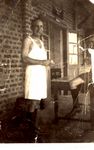 rrant Officer but the initial cost of the uniform; frock coat, cocked hat, sword etcetera was too much for a man without means and married with a son. There were other problems too; retirement was at 55 not 40, too late to get another job. rrant Officer but the initial cost of the uniform; frock coat, cocked hat, sword etcetera was too much for a man without means and married with a son. There were other problems too; retirement was at 55 not 40, too late to get another job.
A W.O. would almost certainly spend even more time at sea and in small ships where he would mess in the Wardroom. This in turn would lead to high mess bills when the ship was entertaining. He had no money for that. The rank is now in line with the Army and RAF: A sergeant major is a senior NCO not a junior officer.
Father came out of the RN in 1935 - not a good time to try and find work. The anguish of my parents looking through the small ads in the Daily Telegraph is still very vivid in my mind.
There was only ever one post in his line, an Explosives Inspector at the Royal Gunpowder Works, Waltham Abbey. He lost to an army man. Oh! the disappointment, Father thought he was the better qualified. He was right, the man who got the job lost it, Dad was invited to reapply but we had already moved to Dartford and he had joined the Post Office, poor pay, boring, but work and with another pension at 65.
Father’s great friend Harry Moorcraft, another Chief Gunners Mate, was successful in getting the post at Waltham Abbey.
Retirement from the Navy did not last long; the crisis in 1938 had him back and on his way to India where he remained for the next 4 ½ years. He joined D.E.M.S., Defensive Equipment for Merchant Ships, as an instructor in Bombay. (Under the Geneva Convention merchant ships were allowed to carry one gun in the stern, manned by a RN Seaman Gunner and crewed by merchant seaman in time of war).
Even when he did get back to the UK, his posting was to Bristol, mother was furious. "Her brother Ern’ hadn’t left HMS Pembroke, Chatham, for years and George was always away" was her justifiable complaint. It must have been very difficult to be married under such conditions. Most of their married life had been disrupted by Father being away.
He was demobbed in 1945 and settled down to civilian life. His hobby was gardening, he liked the theatre, he followed politics and the City. That he was interested in business news and economics was surprising for someone who had never earned very much money. But that was Father - he liked to know what was happening and kept himself well informed.
When I was young our relationship was not easy. I think he found fatherhood difficult; the Navy is not very good training for such matters. I was 18 months old before we met. Accordingly to my mother I woke up and demanded to know "who was that man in her bed?".
Mother "that’s your Daddy, he must sleep somewhere".
Me "well, he can sleep in my cot".
Not a good start for a father and son relationship.
My mother said he was inclined to see his young son as a Boy Seaman unlikely to make the grade unless pulled up sharp. I did not see myself in that role and was inclined to question anything he said. However our encounters did not last long because he spent so much time away from home.
John was born when Father was on the Seamew, a gun boat stationed in China. John would have been over two when Dad returned. When he came home there was a small spell at Chatham and then off to Birkenhead to commission the Achilles, a ship that fought in the Battle of River Plate which ended with the sinking of the Bismark.
After the war, I was demobbed in late ’46, we settled down as a family until I left to have my own place in London. I think that it was after then that we became very good friends. He was always interested in what I was doing and would tell me his news. He was a good man, straight forward, never devious and with a good sense of humour.
JACK
Married Muriel ?. Two children: a girl and boy
of Shepherds Wells near Canterbury.
I only met Jack and his family a couple of times. Father liked him a lot. Jack was a good craftsman but without any ambition. In the late ‘20’s he bought a largish plot of land and built his own house with Muriel as his labourer. Both he and his wife died comparatively young. Mother was in correspondence with the daughter who had married a patient in the hospital where she worked and had returned with him to his home in St Helena, South Atlantic.
GRACE 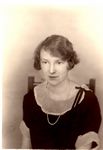
married Alan Pearce of Lydden; a sign writer,
HM Dockyard,Chatham.
Grace had a heart defect, she was a ‘blue baby’, a condition now easily rectified but for her it was a life on the edge. When she was young I think her older sister unduly influenced her (much to the annoyance of my mother) in dividing the family. I hardly ever saw her when young. Much later Marjorie and I went to visit her when she was a fragile, bed ridden old lady who hadn’t left the house for years, there was an oxygen cylinder and mask at hand. There was also a pile of books. Her body was weak but her mind was active. She was really interesting with a fund of family knowledge but by that time she tired very quickly and our stay was short.
Her husband Alan was a quiet, patient man. A nice chap.
|









